Friday, February 25, 2011

Life is not a series of tasks to be accomplished


A golden note of misty light quietly slips through the velvet-black night; noisy birdsong dips and rolls through not-quite morning air. Into my slowly-waking heart, His whisper settles in me:


Life is not a series of tasks to be fulfilled.
It is to be lived and savoured, held close - filled with space and grace – space enough to respond to My call - no matter how inconvenient it may be when it comes.

Oh how well you know me, Father - even half awake you know my mind is already filled with things to do and achieve today, lists to check off. You know how easy it is for me to be structured, maybe even too rigid. How I feel happiest when my list all accomplished. Words that could almost define me - discipline, efficiency, focus...."Come on....time is ticking away", "Hurry up!".


But at the expense of what (or whom)? Are there feelings I have steam-rolled over, children I have nagged and harassed, precious moments I have failed to enjoy in order to finish the task?

Your words of encouragement flow through me -  Life is for living:

When your son builds a fort and wants you to play even though you are in the middle of your devotions.

When your children need a snuggle just when you are desperately trying to answer all your long overdue emails.

To dance in the rain when you are supposed to be cooking dinner.

To watch a movie with the family even though they really should be in bed.

To take your time over a piece of work that you are all interested in even when the schedule tells us it's time to move on.

To lay on the floor and eat cookies, listening to music when the laundry needs doing.

Taking the day off to visit the museum or swim in the pool when there is still much to be done.

To sit and enjoy being with your husband, not rushing to put the kids to sleep.

To embrace life's bumps, surprises, mistakes and allow them to be fertiliser for learning and growth.


Life is for living not just for getting through or surviving.

Sometimes we just have to survive - I know that - I've lived it. But so much more is given to us; a life to embrace even with all its thorns and cut-glass edges. We may bleed but if we feel and live grateful and find peace in the small things, we'll find God: open-armed, smiling, delighting in us. In me. In you.

So today I pray - 

 " I surrender. I surrender my need to control, to have things run according to schedule, to count my worth by what I've achieved each day. I choose to live  - not just survive. I want to learn to be."

As I open my eyes, I see a new day has dawned - brilliant blue streaked with fresh linen-white clouds, mellow golden morning-light dancing off the the tips of towering jade-green trees. I am reminded of this verse from His word: 
Because of the LORD’s great love we are not consumed, for his compassions never fail. They are new every morning; great is your faithfulness. I say to myself, “The LORD is my portion; therefore I will wait for him.  Lamentations 3:22-24
Thankful for new mornings, I start today.



Sunday, February 6, 2011

Music appreciation: All About Jazz Unit Study


One of our favourite CDs to listen to is Jazz for Kids which has an eclectic selection of quirky jazz songs sung by some legendary singers like Ella Fitzgerald (Old Macdonald, The Muffin Man), Slim Gaillard (Potato Chips), Louis Jordan (Ain't Nobody Here But Us Chickens) and of course, Louis Armstrong singing the beautiful "It's A Wonderful World". 


When my daughter recently declared that jazz was her favourite style of music - I thought that I should give her a real taste of what jazz was all about. And being a homeschooler - how could I resist turning it into an educational opportunity?

Below are the links for the unit study and lapbook pieces that I created for our studies. 

Origins of Jazz:

We started off with an introduction to jazz and how it is sometimes termed America’s classical music, We looked up this useful timeline from PBS and discussed how the origins of jazz were rooted in the spirituals and work songs of the African slaves in the plantations. We listened to a few beautiful spirituals sung by Mahala Jackson on Youtube.


Musical Elements in Jazz:

The next week we focused on two elements that are key to jazz – syncopation and improvisation. We used information from this site to help explain syncopation. 


This site provides a helpful explanation jazz improvisation and as always, we discovered some wonderful videos of Billy Taylor explaining and demonstrating improvisation.


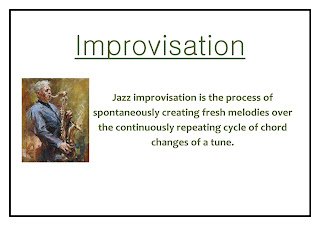
You can download the A4 sized poster definitions of Syncopation and Improvisation that I created for us to put on our walls by clicking on the pictures below.


Early Jazz – Ragtime and Blues
Following that, we talked about how Ragtime was the earliest form of jazz. It is hard not to love this infectious fun musical style. We listened to music by two famous ragtime artistes – Scott Joplin (who wrote The Entertainer) and Tom Turpin.


We also talked briefly about blues music which finds its roots in jazz as well and listened to Bessie Smith, who was called the "Empress of the Blues" and one of the most popular female blues singers in the 1920s and 30s.


New Orleans or Dixieland Jazz
Dixieland jazz, Hot jazz or New Orleans jazz - it is probably a genre that many of us are familiar with. It was a combination of music from the marching bands and funeral parades of New Orleans and ragtime and blues - often played in small bands with brass, woodwind and rhythm instruments. Some famous New Orleans artists included the inimitable Louis Armstrong and Jelly Roll Morton.


We also happened to have this copy of Dixieland Hymns on our shelves which was great to listen to. It is available as an MP3 download from Amazon.com.


Books to read: If I Only Had a Horn: Young Louis Armstrong


Getting to know your Jazz Instruments
I decided to change it up the next week because I bought an excellentpicture book that I couldn't wait to share with the kids.


It is a terrific way to introduce the kids to the different kinds of instruments used in jazz bands and it comes with a fantastic CD. It is a fictional account of a night of jazz played by some of the greats like Thelonious Monk, Ella Fitzgerald, Miles Davis, Charlie Parker, Miles Davis and Max Roach. It is beautifully illustrated and the writing is rhythmic and evocative.

Thelonious Monk invents on the keys, 
Does his own thing, not aiming to please. 
Discordant chords now blend to be 
Pure genius, joined in harmony. 

The CD gives you a taste of each instrument from the drums, piano and different saxaphones - exploring tempos and volume.

I created a lapbook piece on jazz musical instruments and we learnt about the instruments in greater detail as we put it together as a little booklet. Click on the picture to download the PDF document.


We also went onto YouTube and just found examples of the different instruments being played (I do love the internet for resources).


YouTube Examples of:
jazz guitar
jazz drums
jazz saxaphone
jazz trombone
jazz trumpet
jazz piano

Swing Jazz
Swing jazz developed and gained huge popularity from the time of the Great Depression and all through the 1940s. It was characterised by large bands with music you could dance to. Famous swing artistes included Duke Ellington, Benny Goodman and Count Basie. The videos below are of Duke Ellington and his band and the second is a swing dance scene.


Books to read:


Bebop/Scat and Ella Fitzgerald
Bebop developed in the 1940s and in a sense, it arose from a desire for greater creative freedom outside of the big swing bands. It was characterised by more complex melodies and chord progressions We read this lovely picture book about Ella Fitzgerald: A Tale Of A Vocal Virtuoso and we learnt a lot about scatting and Bebop from it.


We watched lots of videos of Ella Fitzgerald singing and were so taken away by her style, grace and talent.She is undeniably wonderful.


Trailblazers in the area of Bebop were Dizzy Gillespie and Charlie Parker.


Books to read: 


Cool Jazz and Hard Bop

The 1950s was as time of experimentation and the result was the emergence of a number of different styles.

Cool jazz was smoother, relaxed and slower in tempo. Miles Davis is a prime example.


Hard Bop was an extension of Bebop but looser, simpler and more soulful. Art Blakely and Horace Silver were pioneers of Hard Bop.


Latin Jazz and Fusion

As its name suggests - Latin jazz was influenced by latin rhythms and melodies.


Fusion combine jazz improvisation and rock music. Herbie Hancock and Chick Corea are famous artists.


That was the end of our tour of jazz!


Some other helpful resources:

My lapbook pieces

Jazz in America - I found this belatedly but it has lesson plans and all sorts of resources if you want to take your learning further.


Scholastic's History of Jazz - lesson plans and audio clips


PBS' Companion site to Ken Burn's film "Jazz" - You can sees parts of the film on YouTube here.


Classics for Kids - Jazz

More books about Jazz:


Wednesday, February 2, 2011

Oops! Broken links on my blog

I've been AWOL for a while with Christmas and travelling over the last two months and as a result, I've just found that my 4Shared account (where I keep my documents for you to download) has been deactivated because I haven't logged in for over a month. How annoying! 

I will be working to upload the documents again and repair the links in due time. So, to anyone who has been trying to get the documents and notes and been unable to - Sorry! 

Hopefully I can get all the links working before long.
:)

LinkWithin

Related Posts with Thumbnails