Showing posts with label Unit Studies. Show all posts

Friday, March 18, 2011

The Aztec and Incan Empires and The Spanish Conquest


Returning to the Americas after the study of the Olmecs and Mayans during our Ancient Civilisations tour was interesting (if not a little more gruesome - with all the human sacrifices!). I am posting a bunch of resources that I found and created for our studies.


I made a few notebook pages to use with our studies. The first is a Quick History of The Aztecs in Pictures.  I created some text boxes and prepared some clip art to add to each box. As we discussed the Aztecs - I had my kids add the pictures to the boxes to create a nice notebook page for their books.


I also created some notebook pages for the Aztecs, Incas and the Spanish conquest. You can download the clip art I used from here (to save you time!).


At the start of each study of a new civilisation, we will usually do some map-work to get an idea of where in the world we are and then we'll learn a little more about the geography, culture. climate, fauna and flora of the new place. This time, after a power point presentation that I created to use with the girls as an introduction - I gave them a list of animals and plants that were indigenous to Central and South American and asked them to do some research on them and add them to index cards which slipped into this lapbook piece. They then pasted it onto a piece of cardstock and added it to their books. The list of plants and animals included:

Cocoa beans
Brazilian nut tree
Pineapples
Potato
Orchids
Armadillo
Chinchilla
Marmoset
Tapir
Jaguar
Llama


You can download the clipart here and you can download the lapbook piece here.

The power-point presentation can be accessed and downloaded here. (Most of the information on it comes from Wikipedia).

We also watched some excellent videos below about the Arenal Volcano in Costa Rica and Michael Palin's trek to the Atacama Desert.


Due to time constraints, we did not do any hands-on activities which I usually like incorporate. You could go into so much more detail with studying the daily life and religion of the Aztecs, their art and craft, farming methods and food, their amazing engineering feats and of course, you have to study all about the fall of the Aztec empire at the hands of the Spaniards. Below is another excellent documentary by the BBC presented by Michael Woods about the fall of the Aztec empire.


Here are some other helpful resources:

http://aztecs.mrdonn.org/  - his site is a goldmine of kid-friendly information, links to powerpoints, games, activities and lesson plans on just about any subject!

Some of the books we used:

Sunday, February 6, 2011

Music appreciation: All About Jazz Unit Study


One of our favourite CDs to listen to is Jazz for Kids which has an eclectic selection of quirky jazz songs sung by some legendary singers like Ella Fitzgerald (Old Macdonald, The Muffin Man), Slim Gaillard (Potato Chips), Louis Jordan (Ain't Nobody Here But Us Chickens) and of course, Louis Armstrong singing the beautiful "It's A Wonderful World". 


When my daughter recently declared that jazz was her favourite style of music - I thought that I should give her a real taste of what jazz was all about. And being a homeschooler - how could I resist turning it into an educational opportunity?

Below are the links for the unit study and lapbook pieces that I created for our studies. 

Origins of Jazz:

We started off with an introduction to jazz and how it is sometimes termed America’s classical music, We looked up this useful timeline from PBS and discussed how the origins of jazz were rooted in the spirituals and work songs of the African slaves in the plantations. We listened to a few beautiful spirituals sung by Mahala Jackson on Youtube.


Musical Elements in Jazz:

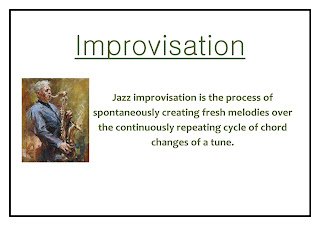
The next week we focused on two elements that are key to jazz – syncopation and improvisation. We used information from this site to help explain syncopation. 


This site provides a helpful explanation jazz improvisation and as always, we discovered some wonderful videos of Billy Taylor explaining and demonstrating improvisation.


You can download the A4 sized poster definitions of Syncopation and Improvisation that I created for us to put on our walls by clicking on the pictures below.


Early Jazz – Ragtime and Blues
Following that, we talked about how Ragtime was the earliest form of jazz. It is hard not to love this infectious fun musical style. We listened to music by two famous ragtime artistes – Scott Joplin (who wrote The Entertainer) and Tom Turpin.


We also talked briefly about blues music which finds its roots in jazz as well and listened to Bessie Smith, who was called the "Empress of the Blues" and one of the most popular female blues singers in the 1920s and 30s.


New Orleans or Dixieland Jazz
Dixieland jazz, Hot jazz or New Orleans jazz - it is probably a genre that many of us are familiar with. It was a combination of music from the marching bands and funeral parades of New Orleans and ragtime and blues - often played in small bands with brass, woodwind and rhythm instruments. Some famous New Orleans artists included the inimitable Louis Armstrong and Jelly Roll Morton.


We also happened to have this copy of Dixieland Hymns on our shelves which was great to listen to. It is available as an MP3 download from Amazon.com.


Books to read: If I Only Had a Horn: Young Louis Armstrong


Getting to know your Jazz Instruments
I decided to change it up the next week because I bought an excellentpicture book that I couldn't wait to share with the kids.


It is a terrific way to introduce the kids to the different kinds of instruments used in jazz bands and it comes with a fantastic CD. It is a fictional account of a night of jazz played by some of the greats like Thelonious Monk, Ella Fitzgerald, Miles Davis, Charlie Parker, Miles Davis and Max Roach. It is beautifully illustrated and the writing is rhythmic and evocative.

Thelonious Monk invents on the keys, 
Does his own thing, not aiming to please. 
Discordant chords now blend to be 
Pure genius, joined in harmony. 

The CD gives you a taste of each instrument from the drums, piano and different saxaphones - exploring tempos and volume.

I created a lapbook piece on jazz musical instruments and we learnt about the instruments in greater detail as we put it together as a little booklet. Click on the picture to download the PDF document.


We also went onto YouTube and just found examples of the different instruments being played (I do love the internet for resources).


YouTube Examples of:
jazz guitar
jazz drums
jazz saxaphone
jazz trombone
jazz trumpet
jazz piano

Swing Jazz
Swing jazz developed and gained huge popularity from the time of the Great Depression and all through the 1940s. It was characterised by large bands with music you could dance to. Famous swing artistes included Duke Ellington, Benny Goodman and Count Basie. The videos below are of Duke Ellington and his band and the second is a swing dance scene.


Books to read:


Bebop/Scat and Ella Fitzgerald
Bebop developed in the 1940s and in a sense, it arose from a desire for greater creative freedom outside of the big swing bands. It was characterised by more complex melodies and chord progressions We read this lovely picture book about Ella Fitzgerald: A Tale Of A Vocal Virtuoso and we learnt a lot about scatting and Bebop from it.


We watched lots of videos of Ella Fitzgerald singing and were so taken away by her style, grace and talent.She is undeniably wonderful.


Trailblazers in the area of Bebop were Dizzy Gillespie and Charlie Parker.


Books to read: 


Cool Jazz and Hard Bop

The 1950s was as time of experimentation and the result was the emergence of a number of different styles.

Cool jazz was smoother, relaxed and slower in tempo. Miles Davis is a prime example.


Hard Bop was an extension of Bebop but looser, simpler and more soulful. Art Blakely and Horace Silver were pioneers of Hard Bop.


Latin Jazz and Fusion

As its name suggests - Latin jazz was influenced by latin rhythms and melodies.


Fusion combine jazz improvisation and rock music. Herbie Hancock and Chick Corea are famous artists.


That was the end of our tour of jazz!


Some other helpful resources:

My lapbook pieces

Jazz in America - I found this belatedly but it has lesson plans and all sorts of resources if you want to take your learning further.


Scholastic's History of Jazz - lesson plans and audio clips


PBS' Companion site to Ken Burn's film "Jazz" - You can sees parts of the film on YouTube here.


Classics for Kids - Jazz

More books about Jazz:


Wednesday, November 3, 2010

A Study On Clouds


I love nature and I'd like to get out more, but as I explained in my last post, we just don't. Clouds (and stars actually) have long held a fascination for me. So I guess it was only a matter of time that I would find a way to incorporate it into our nature studies. 

Most recently, I started having the girls observe the clouds on a fairly regularly basis, making sketches and noting the weather. To help them, I printed out a cloud guide from here to help them identify the clouds. 

While doing this, the girls complained that it was hard to draw clouds properly and this seemed like a great opportunity to link in an art lesson or two on "How to paint the sky". And then, I thought why not turn it into a fun unit study? So I declared an "All About Clouds" day and quickly put together a unit study on clouds which would allow us to delve more deeply into all areas of the subject. 

After the usual morning's task of cloud sketching and identification was completed, we started our day reading the following books:


John Day's Book of Clouds is a beautiful photographic portfolio of clouds which is organised and explained very clearly. We "ooh-ed and ahh-ed" over many of his photos and absorbed a great deal of new information . The Man Who Named The Clouds is a lovely simple picture book which packs a lot of learning into a easy read.  It combined biography, history and weather science.

In my opinion, a study on clouds lends itself perfectly to poetry and art appreciation. I picked out a few simple little poems to read and focused particularly on the idea of Imagery.


Clouds
By Christina Rossetti


White sheep, white sheep,
On a blue hill,
When the wind stops,
You all stand still.
When the wind blows,
You walk away slow.
White sheep, white sheep,
Where do you go?
 

Rain Rain
by Jame Horner

Rain rain
falls on the street,
mud in puddles
cleaning my feet.

Thunder thunder
rumble and roar,
close the windows
and lock the door.

Clouds clouds
black and gray,
heavy with water
to drop all day.

Sun sun
is breaking through,
clouds are moving,
the rain stops too.

Rainbow rainbow
across the sky,
see-through colours
to tickle my eyes.

And then we tackled Percy Shelley's longer, more complex poem, aptly named The Cloud. We took it verse by verse and discussed the language, imagery, alliteration, assonance and personification. It is a long poem and we only looked at the first three verses. You can read the whole poem here.

The Cloud
By Percy Bysshe Shelley

I bring fresh showers for the thirsting flowers,
From the seas and the streams;
I bear light shade for the leaves when laid
In their noonday dreams.
From my wings are shaken the dews that waken
The sweet buds every one,
When rocked to rest on their mother's breast,
As she dances about the sun.
I wield the flail of the lashing hail,
And whiten the green plains under,
And then again I dissolve it in rain,
And laugh as I pass in thunder.

I sift the snow on the mountains below,
And their great pines groan aghast;
And all the night 'tis my pillow white,
While I sleep in the arms of the blast.
Sublime on the towers of my skiey bowers,
Lightning, my pilot, sits;
In a cavern under is fettered the thunder,
It struggles and howls at fits;

Over earth and ocean, with gentle motion,
This pilot is guiding me,
Lured by the love of the genii that move
In the depths of the purple sea;
Over the rills, and the crags, and the hills,
Over the lakes and the plains,
Wherever he dream, under mountain or stream,
The Spirit he loves remains;
And I all the while bask in Heaven's blue smile,
Whilst he is dissolving in rains.

After reading all that poetry, we had to try our hand at writing some of our own. So I instructed the girls that they were going to write a poem in free verse. We started off with a five minute freewrite where they could get all their thoughts down about on paper without worrying about spelling or grammar. Then they took a short break and came back to their work. They highlighted phrases and ideas that they liked and then off they went, using those phrases and ideas as a jumping off point for writing their own 

In the afternoon, we moved onto learning how to paint clouds. I think this was the highlight for us and we had a lovely time experimenting different techniques and ideas.We used these Youtube videos to start us off and then after that we looked at photos from The Book Of Clouds and tried to paint our favourite pictures. 


I belatedly found this lovely Cloud Art slideshow at Hearts and Trees, which I will definitely use for more art appreciation on how different artists paint clouds.

We finished up by reading a general book on weather and exploring some weather terms but not in any great detail. We also used some very helpful worksheets from here to complete our studies. We'll probably have to come back to do a more comprehensive study at some point but all in all, it was an enjoyable day of learning. 


Friday, April 30, 2010

The Mughals: Treasury Of The World


My girls went along to the The Treasury Of The World special exhibit at the Asian Civilisations Museums recently. It is running from 12 February to 27th June 2010.

It looks at the Arts in India during the time of the Mughals. They were particularly known for their extraordinary opulence and lavish lifestyles. It is a fascinating travelling exhibition that has been displayed at the British Museum, the Metropolitan Museum in New York and the Louvre, Paris. 


If you plan to go, I would highly recommend going on the guided tour, my girls picked up many interesting anecdotes and  information about the beautiful jewels and objects from that session which really brought history alive. As I couldn't accompany them due to illness, I asked my eldest to take lots of photos and to come back and give me a full and detailed account of their time there. I have to say she did a great job and I got very excited about it!


From the photos she took, it is quite apparent that the Mughals loved their jewels and they covered everything and anything in them!


This is a jewel encrusted copy of the Koran and its outer covering.


They wore pearls with everything and one was not considered dressed unless draped in them.

This is the back of a jewel that is fixed to a crystal wine glass and they painted faces on the back so that the guests of the Emperor could amuse themselves looking at them while they waited for the glasses to be refilled!


This giant red Spinel was given to Emperor Jahangir who carved his name on it as well as his father's.  It was then passed down to subsequent Emperor's. It is said that when his favourite wife scolded him for defacing such a beautiful gem, he replied "This jewel will more certainly hand down my name to posterity than any written history."

There are many more magnificent pieces in the exhibition with fascinating stories behind them.

It was hard to find books written for a younger audience specifically about the Mughals, so I resorted to getting books on Ancient India from the library and reading from the section on the Mughals and books about the Taj Mahal - one of the most famous Mughal monuments built by the Emperor Shah Jahan. We had to use the internet for information on the Emperors. These two websites were quite informative:


I created a number of notebooking pages so they could record the things that they had learnt from the tour.


Mughals Notebook pages- this contains a general notebook page on The Mughals, The Emperors and The Taj Mahal


The Treasury Of the World notebook page- I printed out the photos the girls took and they pasted it onto the notebook sheet and wrote some facts about each object. 


It was a wonderful learning opportunity and truly fascinating!

LinkWithin

Related Posts with Thumbnails